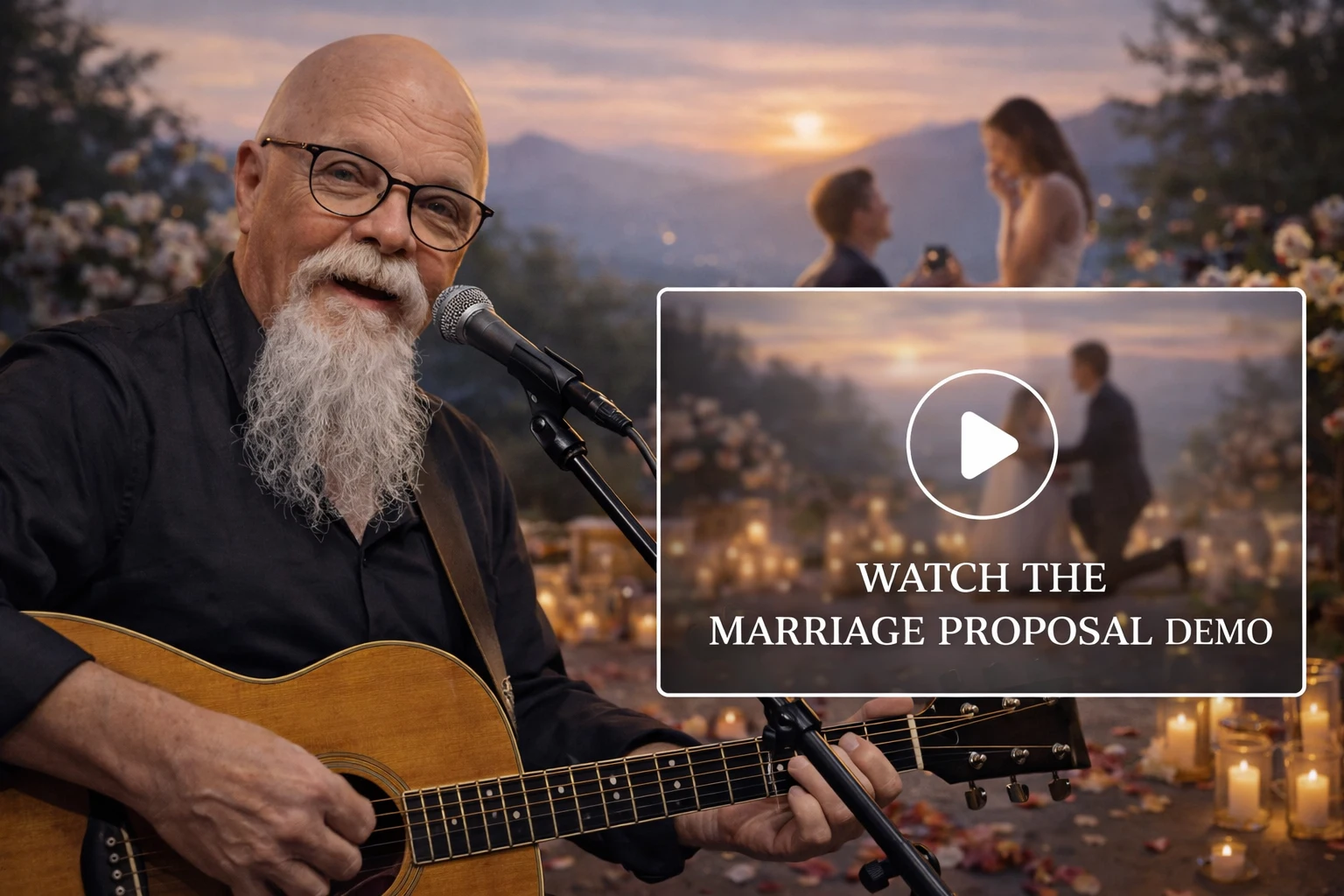
↑↑ WATCH THE SIZZLE REEL ABOVE ↑↑
The distinction between a musician and a backing-track player is profound. A backing track commits to its tempo, volume, and arrangement before the proposal begins. It cannot adapt if the moment calls for something different.
Phillip Rogers performs live—both vocals and guitar, with no backing track. He watches you kneel. He hears her breathing change. He feels the precise moment when anticipation becomes certainty. Since he's not locked into a predetermined arrangement, every element of the performance can shift in response to what's unfolding: a held note when the moment needs air, intensified emotion when she realizes what's happening, silence when it says more than sound.
The result is a proposal that feels entirely yours. The music serves the moment instead of a template. The performance adapts to reality instead of forcing reality to fit the music.
A waterfall proposal where power outlets don't exist. A private cabin where you want nothing visible until the moment. A restaurant intimate enough that amplification would be wrong. Most proposal musicians require a power source, which eliminates these possibilities. Phillip doesn't.
His entire setup runs on batteries—guitar, monitor, any amplification needed. This removes a constraint: you're not limited to venues with available electricity. Waterfalls, mountain overlooks, private cabins, lakeside settings—locations you might otherwise rule out become possible.
He positions himself where you want him based on what matters to the moment: visible enough that she registers his presence, or subtle enough that the focus stays entirely on the two of you. Either way, the technical setup is invisible—just a musician and the music.
Phillip begins with a conversation designed to eliminate guessing. He learns what you're envisioning, how you want the moment to feel, and what logistical details matter most. He talks through timing, positioning, song choices, and backup plans—not to over-script the moment, but to ensure you know exactly what will happen and why. By the end of that conversation, your logistics anxiety should be gone. What remains is anticipation.
On the day, he arrives early to test everything and position himself exactly where the moment requires. When you signal you're ready, he begins playing at that precise moment—fully present, completely attentive to you both. His role shifts from planning to pure musicianship: listening, observing, responding. The tempo becomes fluid. The dynamics shift naturally. The music creates an emotional landscape instead of imposing one.
After the proposal, he follows your lead. Celebrate with music. Sit in quiet. Whatever the moment calls for.
When you reach out, you're talking to Phillip directly—not an agency, not a booking coordinator. His approach isn't transactional. It's collaborative. He listens to your vision and thinks through every detail that could affect the outcome.
Your consultation covers far more than a typical booking. You'll establish the exact timeline: when he should arrive, how much setup time he needs, when you want the music to begin. Together, you'll plan positioning: where he should stand so she notices him, or stay subtle if the focus should remain on you both. You'll address sight lines, camera angles for photographers, coordination with restaurant staff if it's a venue event, and briefing anyone who needs to know he's coming.
He'll ask about weather contingencies, walking distances, acoustic challenges, and backup plans. You'll work through his arrival sequence, equipment setup, sound check, and the final signal that tells him you're ready. For multi-person events, you'll plan the dynamic. For intimate moments, you'll adjust accordingly. Nothing gets left to assumption.
Song selection gets similar attention: if you have specific choices in mind, you'll discuss what's musically feasible and how each serves the proposal. If you'd prefer real-time choices based on the moment's energy, he'll explain how that works. Either way, you'll know exactly what to expect.
When the conversation ends, uncertainty is gone. You'll know precisely how the proposal will unfold and his role in it. You'll have asked every question that matters. The only surprise left is her answer.
If you're planning a destination proposal, he coordinates those too—with the same thoroughness, just with added logistics for travel and unfamiliar venues.
Location determines everything: acoustics, visibility, weather, crowd presence, distance, setup limitations, sight lines, and intimacy. A restaurant proposal isn't just different from a waterfall; it's fundamentally different. So is an at-home proposal, a private garden, a mountain overlook, or a lakeside ceremony. Each environment requires a different approach.
Experience in different settings teaches a musician how to adapt. Phillip adjusts vocal power and guitar volume based on how sound behaves in open air versus closed rooms. He knows restaurant noise requires different phrasing and clarity than a quiet outdoor setting. He reads distance and sightlines to determine if she'll hear a whisper or needs projection. He recognizes when confinement calls for restraint and when space allows dynamics to breathe. The weather, light, crowd, and acoustic reality shape his entire approach—technical, personal, and musical.
This isn't flexibility for its own sake. It's precision in service of one goal: making sure your proposal feels exactly right for the location and moment you chose. Your vision determines the setting. Musicianship determines how it comes to life.
How you want to do this shapes everything. A surprise proposal has different coordination needs than one she knows about. An at-home proposal is different from a restaurant proposal. A simple proposal is different from an elaborate one. All of them work. All of them matter equally.
Short clips look polished. They hide what you actually need to know: Can he sustain a vocal through an entire song? Does his musicianship hold up under real-time performance? Is his artistry consistent, or just occasional? How does he handle unexpected moments in a live setting? Is his presence professional and calm, or performative and distracting?
Phillip publishes complete songs—two, three, four minutes each—so you can evaluate what actually matters. Watch his vocal ability and consistency across an entire performance. Observe his musicianship: how he paces, interprets a song, makes choices with arrangement and dynamics. Notice his stage presence, his focus, his professionalism. Judge whether his artistry aligns with what you want your proposal to feel like.
This is intentional. You're not hiring based on a highlight or a marketing image. You're making a decision about the actual person who will be there on one of the most important days of your life. The voice you hear and the musician you see are exactly who will perform your proposal.
Watch the catalog. Listen to how he sustains a performance across verse, chorus, and bridge. Notice the choices he makes, the phrasing, the way he responds to the song itself. Assess whether this is someone whose musicianship you trust and whose presence feels right. If he is, you already know it. If he isn't, you've saved yourself from a mistake.
By the time you reach out, the decision has already been made. You know exactly who you're hiring.
Years from now, you'll remember details you didn't know you'd remember. The exact song. The exact moment in that song when something shifted. The way the light hit her face. The way your heart felt.
Phillip's music becomes part of that memory. When you hear that song again—years later, on the radio, at a wedding—it will transport you back to the moment you asked her to marry you. The song and the moment will be inseparable in your memory. That's the opposite of background music. That's a memory made tangible.
Phillip understands this isn't simply about performing. It's about creating the emotional foundation for one of the most significant memories of your lives. His entire approach—the preparation, the consultation, the focus on your specific moment, the live musicianship that adapts to what you're experiencing—all of it is in service of that one goal: making sure the music and the moment become one.
When you're ready, reach out directly to Phillip. Share your date, your location, and your vision for the proposal. He'll respond personally, think through every detail with you, and make sure you feel completely confident. Proposal day will arrive with all the logistics handled, all your questions answered, and nothing left for you to worry about except the moment itself—and the music that will make it unforgettable.